- FAA’s ungrounding of the 737 MAX and progress on the COVID vaccine have lifted the overhang on the company substantially.
- Airline industry metrics and CFO surveys on the profit outlook show that the sector has already bottomed out.
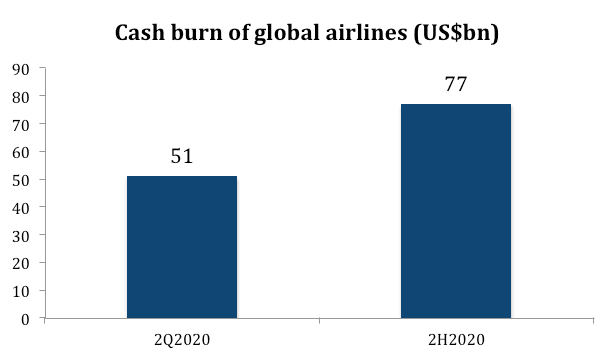
- The scope of government support is underappreciated – 2020 global airline cash burn has been more than covered by support measures to the sector.
- A strong wave of pent-up demand is brewing, as household savings rates due to forced savings during lockdown have surged. This should help drive a sharp rebound in air travel.
- Green shoots are sprouting for Boeing. Now is the time to go long on this quality value stock, not when we get clear skies with the stars aligned.
The announcements of two highly successful Phase 3 trials for the COVID-19 vaccine by Pfizer/BioNTech (NYSE:PFE) (NASDAQ:BNTX) and Moderna (NASDAQ:MRNA) have lifted a substantial overhang on the aviation sector, giving investors hope that the worst is behind us. In another piece of good news, the FAA announced on November 18 that the Boeing 737 MAX has been cleared for return to commercial service, after about a year and a half of being grounded in the wake of the fatal Lion Air and Ethiopian Air accidents.
Admittedly, visibility on the timeline of a recovery remains low, with many moving parts (notably around the distribution and production of a COVID vaccine). Yet, industry metrics and airline CFO survey results both point to the fact that the aviation sector has already bottomed out. Now should be the time to buy into quality value stocks like Boeing, not when we see clear blue skies.
737 MAX ungrounded
As of Sep. 30, 2020, Boeing’s 737 program, consisting mainly of the 737 MAX, accounted for about 78% (or 3,404 planes) of Boeing’s Commercial Airplane firm orderbook by number of airplanes. I suspect the number of firm orders for the 737 MAX alone stand at about 3,100 (as that is the number of units they have divided the announced incremental grounding costs by), which equates to 71% of Boeing’s commercial orderbook. That is significant. The ungrounding of the 737 MAX therefore enables Boeing to resume monetizing this program, albeit at lower margins than pre-grounding of the fleet. Despite lingering reputation scars, airlines have an incentive to add the 737 MAX to their fleets, lest the Airbus A320s take too high a market share and Airbus’s pricing power grows too large.
As of Sep. 30, 2020, Boeing had 450 units of 737 MAX airplanes in inventory. The company has also guided for two additional costs related to the 737 MAX grounding: i) $6.3bn of additional costs related to the delays in production and delivery, to be spread out across 3,100 planes; ii) $5.98bn in outstanding customer concessions relating to the delay of these planes. The Boeing 737 MAX family has a list price of about $120m on average, though in practice this is discounted by 50-60%, so let’s assume the average price is $50m to be conservative. Prior to the 2019 grounding, Boeing’s Commercial Airplanes segment was making EBIT margins of about 14%. This translates to about $7m in EBIT per 737 MAX delivered. The additional U$12.28bn ($6.3bn + $5.98bn) of costs translates to about $4m per plane. Using this simple calculation, the EBIT per 737 MAX would be about $3m per plane or a 6% EBIT margin going forward. That equates to $9.3bn in EBIT to be unlocked over the lifespan of the 737 MAX firm order delivery timeline, which is a meaningful number compared to Boeing’s current net debt of $34bn.


