- Stock has rallied too quickly in my opinion.
- Downward revenue/earnings revisions continue.
- Cash burn still high, although debt raise better than last.
Back in October, I detailed a few reasons why I believed shares of aerospace giant Boeing (BA) were ready for takeoff again. At that time, we had just received positive news on the 737 Max, and the company was likely about to report a bottom in quarterly revenues for now. Shares of the stock have certainly jumped since then, but at this point I think investors need to be a bit more cautious given the latest set of results.
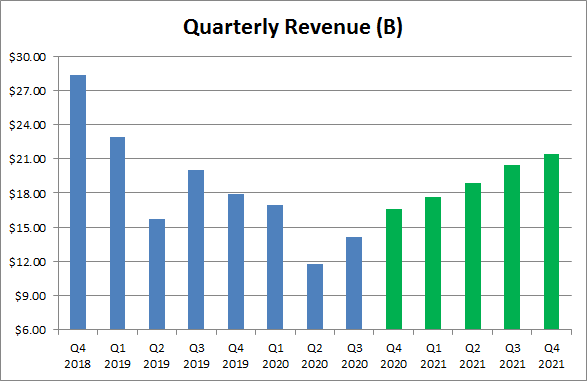
When the company reported Q3 results, it did beat on the top and bottom line, but that was partly due to significantly reduced estimates. Revenues of $14.14 billion were about $350 million below where street estimates where when my previous article was written. The next few quarters are expected to see better top line figures as seen in the chart below. However, the five quarters through the end of 2021 have seen their quarterly revenue estimate averages come down by nearly $4.8 billion in total since my previous article.
Previously, the Q4 2021 revenue estimate average represented a decline of 20.71% from the $28.34 billion figure reported in Q4 2018. Now, that average is down to a projected decline of 24.45%. Less revenues coming in, as well as more projected expenses have also resulted in much sharper declines in earnings estimates. Over the past three months, the 2021 adjusted EPS average on the street has been whacked by almost 49%.
A weaker business moving forward will also likely mean free cash flow projections need to come down. Boeing burned through $4.8 billion in Q3, which was an improvement from the $5.3 billion seen in Q2, but it is still a lot. As a result, the company did tap the debt markets again as the table below details. This debt deal did get much better rates, reflecting some improved sentiment in the long term picture, but this was also a massively smaller raise at just $4.9 billion as opposed to the $25 billion raise earlier this year.
READ FULL ARTICLE HERE


