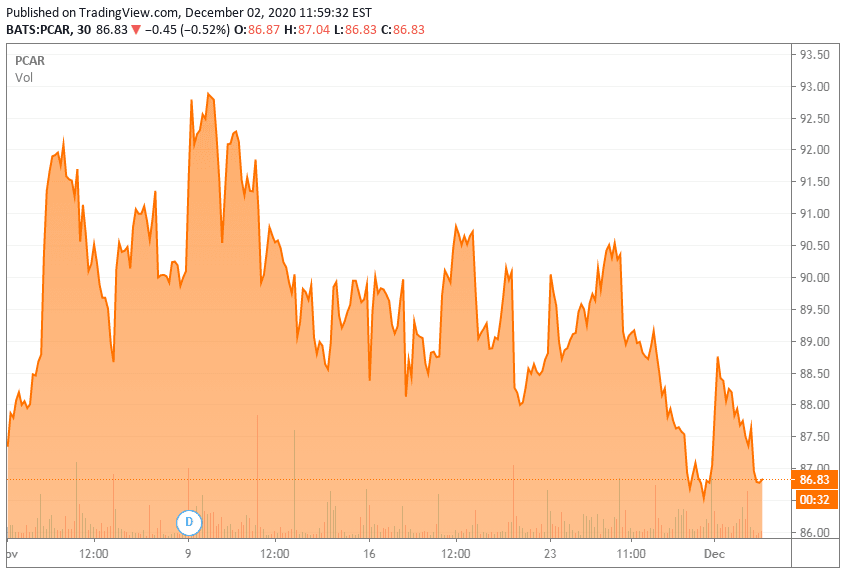
- 2020 has proven to be a tough year for most firms, including PACCAR.
- Despite this, the future is looking bright for the industry leader.
- It’s unlikely to make investors rich, but in the long run, its prospects should be attractive for the right kind of investor.
- Looking for a helping hand in the market? Members of Crude Value Insights get exclusive ideas and guidance to navigate any climate. Get started today »
One often overlooked vehicle manufacturer on the market these days is PACCAR (PCAR). The manufacturer of trucks under the Kenworth, Peterbilt, and DAF brands, the company is a significant player in this space. In addition to having a significant presence in other markets, the firm holds a 30% market share in the US and Canadian Class 8 markets. Over the years, the firm has demonstrated its quality, strength, and stability, but 2020 has been a trying year for the business. Despite the weakness the firm has experienced so far this year, the future for it looks bright and fundamentally it makes for an attractive long-term play for patient investors to consider.
A look at PACCAR
It would be a lie to say that PACCAR has had a spectacular year. If anything, the opposite has proven true. To see this, we need only look at the firm’s latest performance, covering the third quarter of its 2020 fiscal year. According to management, revenue in the latest quarter came in at $4.54 billion. This is down 24.4% compared to the $6 billion the company generated the same quarter last year. As revenue fell, profits tanked, falling 36.6% from $607.9 million to $385.5 million. Naturally, demand for trucks would be weaker given the state of the economy, though there’s no doubt that in the long run the picture will be attractive when you consider that a growing population (particularly one that is moving more toward ecommerce every day) will result in long-term growth in trucking demand.
The third quarter wasn’t the only period the company suffered in though. Really all of 2020 as a whole has been an issue for the company. In the first three quarters of the year, revenue came out to $12.02 billion. This is 34.7% lower than the $18.41 billion the company generated the same three quarters last year. This is especially due to a nasty second quarter in which sales were down 56.9% year-over-year. As revenue fell, so too did the firm’s net profit. During the first three quarters this year, net income came out to $892.6 million. This is 51.9% lower than the $1.86 billion the company generated the same time frame of 2019.
There really was only one way in which PACCAR has fared well for the current fiscal year: operating cash flow. According to management, this metric year-to-date has totaled about $2.19 billion. This is 14.4% higher than the $1.92 billion seen a year earlier. Before you get excited, though, consider how cash flow can be easily manipulated. Changes in working capital, driven by management’s timing of various cash-based activities, can cause cash flow to look better than it otherwise would have been. Case-in-point, if you remove changes in working capital from the equation, operating cash flow would have fallen 40.4% from $2.70 billion last year to $1.61 billion today. Though, there were several factors affecting this, like trade and other receivable changes and accounts payable and accrued expense changes. The largest, though, was a $1.26 billion swing associated with whole receivables involving new trucks.


