- CEO knocks down idea of large capital raise via equity sale.
- Net debt position continues to increase, but may turn soon.
- Positive free cash flow will help reduce interest expenses too.
The last couple of years have been very tough financially for aerospace giant Boeing (BA). Between the 737 Max crisis and the coronavirus, revenues have plunged and losses have piled up. As a result, the company has burned through tons of cash, leaving it with a massive debt pile. One analyst recently suggested that Boeing will need a large equity sale to change the situation, but the company’s CEO has quickly knocked down that idea.
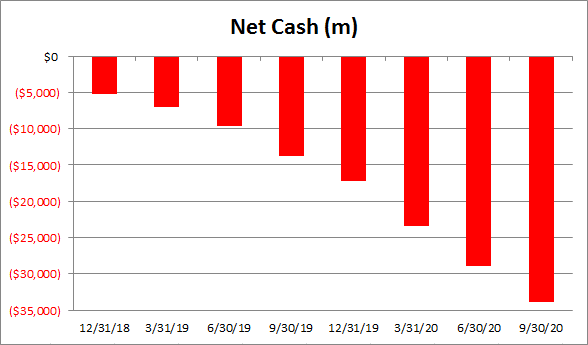
While 2019 got the ball rolling, this year is where things have gotten much worse. As you can see in the chart below, Boeing’s balance sheet has taken a major hit, with the net debt amount almost at $34 billion at the end of Q3. This number has nearly doubled in just three quarters, and we’ll likely see more cash burn when the current quarter is reported.
Now the capital markets have been open for Boeing, allowing the company to take on tens of billions in debt over this period. Eventually, however, that money comes due, and you don’t necessarily want to pay tons of interest forever. Thus, one analyst earlier this week discussed the idea of what could happen down the road to fix this situation.
In a note Tuesday, Morgan Stanley said that the airplane manufacturer could raise between $20 billion and $30 billion, an assessment that comes nearly two weeks after Boeing’s finance chief said it would consider any opportunity, including equity, to reduce debt on the balance sheet. Morgan Stanley said that could dilute outstanding shares by up to 20%.
As the article above details, however, Boeing CEO David Calhoun said this was a non-starter, and claimed the idea was highly speculative. However, it’s probably not out of the question that a smaller equity sale could happen at some point, if management decides that’s the best course of action. If shares get back to the point where the market cap is $200 billion or more, maybe a sale that would dilute in the low single digits percentage wise happens.
At this point, however, Boeing management as well as investors are hoping that the situation will quickly turnaround. The company has recently started to deliver 737 Max planes again. That should lead to higher revenue, getting back to profitability, and positive free cash flow. Sure, results won’t get back to their pre-crisis levels anytime soon, but they don’t have to for the financial situation to start to improve over time.
Just like the snowball getting bigger as it rolls down the hill, making progress on the cash flow situation will eventually grow on itself. As the chart below shows, Boeing had quarterly interest expense of $643 million in Q3 2020, which is a more than $2.57 billion annual run rate. That run rate is up more than $2 billion in just six quarters, and probably has not peaked just yet, especially as Boeing borrowed more money back in October.


