Summary
- BioTelemetry, the primary and only real contender for iRhythm, was just acquired by tech giant Philips.
- BioTelemetry’s product line will be rapidly placed on the forefront of the Philips’ Connected Care Solutions business, which will vastly diminish the available market size for iRhythm.
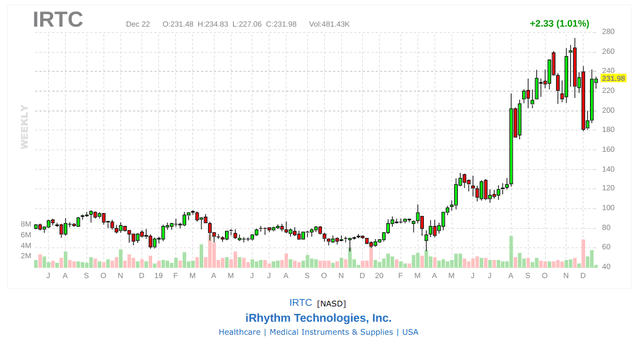
- Still unprofitable, iRhythm appears more vulnerable than ever with shares inflated nearly 300% in the past year.
- Recent changes to reimbursement codes for iRhythm products provide limitless uncertainty to the future of the company, with a decision by CMS due by year end.
iRhythm Technologies (IRTC) is a digital healthcare company focused on combining wearable biosensing technology with cloud-based data analytics and deep-learning capabilities. This field will be among the most important in the biotechnology space in the near future, as cardiovascular disease remains atop America’s causes of death (nearly 1 in 4 deaths are related to heart disease).
The product line offered by iRhythm consists of the Zio single-use cardiac monitoring device, described by the company as “a complete ambulatory cardiac monitoring solution built with the patient in mind”. The device can be worn for up to 14 days, all the while recording the patient’s cardiac activity which may then be analyzed by the patient’s physician.
While this combination of real-time healthcare monitoring and cloud analytics is a brilliant addition to the world of healthcare, unfortunately for iRhythm, the “other guys” just won the battle.
Highly similar technology developed and marketed by BioTelemetry (BEAT) has just been acquired by tech giant and multinational conglomerate Philips (PHG).
Simple Performance Metrics Explain Liking of BioTelemetry for M&A
Despite the significantly lower market cap of BioTelemetry ($2.5b) compared to iRhythm ($6.6b), BioTelemetry has outperformed iRhythm on both product sales and managerial efficiency/margins over the past five years. Pictured below are the revenue and net income for each of the companies since 2016:
As the figures show, BioTelemetry has remained the market leader in the cardiac monitoring space for the better part of the last decade, capturing two thirds compared to one third of the combined product revenue of the two companies in 2019. Despite an impressive 50% revenue increase in 2019 for iRhythm, 2020 signals a sharp halt in the product growth and remains well below what BioTelemetry has retained. Moreover, the remarkable 2019 product growth posted by iRhythm was overshadowed by an increase in net losses for the company.
Now, iRhythm faces a profoundly more daunting opponent with an established network and resources to seize the market rapidly. If iRhythym couldn’t manage to outperform BioTelemetry as a standalone small-cap company, it is safe to say they will not find success in the wake of this major acquisition that will propel competitor products globally.


