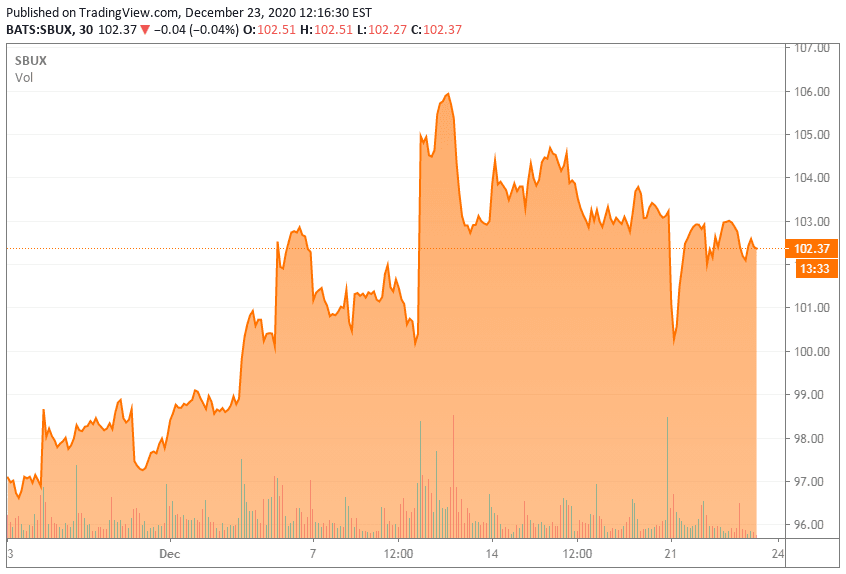
- Starbucks has reaffirmed its strategy and its commitment to the US and Chinese markets.
- Financial targets have slightly been raised and long-term growth prospects remain strong.
- Current share price does not provide an attractive entry point.
Starbucks (SBUX) recently hosted a virtual investor day in which the management team reaffirmed its strategic ambitions and updated its financial targets. Such event is generally held every two years. Overall, the presentation was reassuring and confirms our positive stance on the company.
NB: The fiscal year ends at the end of September.
Strategy
Starbucks will keep focusing and investing into its core US and Chinese markets by enhancing its digital platform and delivery capabilities and pursuing beverage innovations. Besides, the company also wants to strengthen and further expand its retail business through its partnerships with Nestle and Pepsi in order to increase its “at home” presence in which the group is currently underexposed. Finally, the company is also considering licensing some non-core markets.
Financial targets
Overall, most financial targets have been slightly upgraded. Starbucks expects that the business will recover by the end of FY 2022. For that reason, long-term targets will come into effect from FY 2023 as short-term results will be much stronger. Revenue growth is expected to grow 8%/10% (7%/9% previously), driven by 4%/5% same-store sales growth (3%/4% previously) and 6% store growth (6%/7% previously). The company guides for 18%/19% operating margin (17%/18% previously) which should translate into 9%/11% operating income growth. EPS should grow 10%/12% per year (at least 10% previously), thanks to the benefit of share count reduction which adds one incremental percentage point of EPS growth.
Unit growth
The number of stores should grow by ~6% annually from FY 2022 to FY 2024. This target has been the only one below prior guidance as it becomes more difficult to grow from a larger base. In details, US store count is expected to grow by ~3% annually (3%/4% previously) while Chinese net unit growth rate is expected to be in the low-teens (mid-teens previously).
Some investors could be worried that Starbucks faces declining growth opportunities. However, the company has also mentioned its long growth runway and introduced a long-term store openings target. Starbucks wants to reach 55,000 stores and be present in ~100 markets by FY 2030. This compares to an existing store base of 33,000 stores in 83 countries (in FY 2020). This target implies 2,200 net new stores per year for the next 10 years, which is equivalent to a ~5% CAGR for the decade.
In addition to an increase in the number of stores, Starbucks is going to remodel its US store portfolio. Given that roughly 80% of sales were already on-the-go before the COVID-19 outbreak, Starbucks wants to increase its exposure to drive-thru and pickup locations to nearly 45% of the US portfolio by FY 2023 (vs. 10% in FY 2020). In order to reach that goal, the company will remodel several existing stores and most of new store openings (80% of the total new openings) will be based on a drive-thru and pick-up formats.
New store openings offer very attractive economics. According to the company, returns on investment approach 50% and 70% for US and Chinese new projects, respectively. These high returns are possible because initial investments are not inflated by capital-intensive kitchen investments while the company’s asset turnover (sales / total assets) is large and its profitability is strong because its beverage products are sold at high price points and do not require extensive advertising due to the strength of the Starbucks brand.


