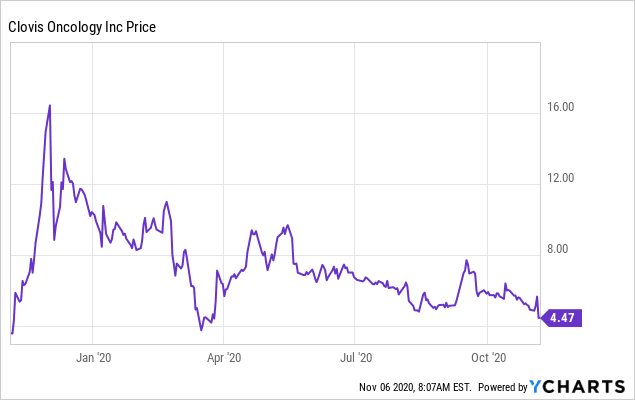
- Clovis Oncology is a higher-risk holding that has significant risk baked into the future outlook, and larger players have better product labels in our view.
- The company’s cash position is tight, and we question the runaway guided by management, plus see evidence of poor liquidity through the recent convertible note issuance.
- Further evidence of the above is seen through recent severances, higher cash burn and paper thin sequential sales of Rubraca YTD.
- Key catalysts are not for another 1 to 2 years, on the back of readouts in studies planned for 2021 and 2022, thus price direction seems unpredictable for now.
- We hold a neutral stance on the company, until the case for immediate entry can be made more compelling from positive developments in the story.
Thesis Summary
We believe that Clovis Oncology (CLVS) is a high-risk investment for those seeking oncology exposure at this stage, namely on the back of thin organic growth in Rubraca for ovarian cancer. We also firmly believe that other names have better labels than CLVS, particularly AstraZeneca’s (AZN) Lynparza and GlaxoSmithKline’s (GSK) Zejula; both of which have created a significant market disadvantage to CLVS’s oncology thesis. CLVS is pushing Rubraca’s new approval for prostate cancer, which is based on single-arm study data, but this also faces heavy pushback from AZN’s Lynparza, which has far greater underlying evidence. Without significant mitigation to these market risks, notwithstanding the commercial risks for CLVS’s label, the case for immediate entry is less compelling.
Shares have given away -57% YTD, whilst other names have seen high double-digit growth on the back of successful commercialization of their labels. We also see the company struggling for cash at this point in time, against management’s guidance, as thin sales growth in Rubraca and declining sales this year offset the cash position further. To illustrate, Rubraca recorded another sales decline in Q3, secondary to high competition and COVID-19 headwinds, which means contribution to expanding and converting the pipeline was underwhelming over this period. Furthermore, growth catalysts are contingent on key readouts that will occur not until late 2021 and 2022, where a collaboration with Bristol-Myers Squibb (BMY) may drive top-line earnings and share price from that point.
The Cash Position Is Tight
Rubraca sales showed another slow quarter with sequential sales decline from the Q3 exit, on top of declining sales in Q2. The company exited Q3 with $225 million in cash, with ~$90 million of financing for the ATHENA trial remaining. Whilst management have advocated their cost-savings strategy, a recent organizational restructuring doesn’t necessarily quantify, in our view. Further, the company’s new debt offering and debt exchange further highlight the cash-tight situation. On the back of the lackluster sales this year, growth is heavily tied to the readouts expected in 2021 and 2022. Cash burn will therefore be of utmost importance for investors to monitor, especially considering we can’t rely on the thin sales growth in the current oncology segments from the company.


