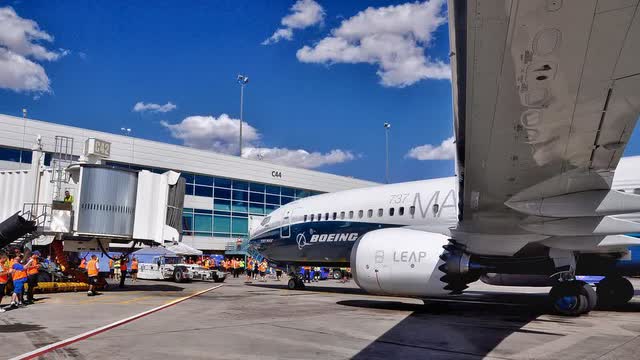
- Boeing 737 MAX has been ungrounded by the FAA.
- There are costs involved to make the required changes.
- These costs are significantly lower than some have believed.
- Looking for a helping hand in the market? Members of The Aerospace Forum get exclusive ideas and guidance to navigate any climate. Get started today »
We have seen Boeing making some nice price movements. While I haven’t been especially upbeat on the prospects for share prices for the better part of the past two years, when share prices finally headed into the sub-$100 region as we had expected based on Boeing 737 MAX crisis costs projections, we marked the opportunity on Boeing based on the reason for the sell-off (which was not the Boeing 737 MAX crisis) and subsequently we recognized that Boeing would start moving based on a combination of Boeing 737 MAX timeline convergence and positive vaccine news even though the company’s fundamentals would not improve rapidly. Given that Boeing shares indeed did head to the anticipated price range and subsequently went to $200+, more than doubling in value, the call was right in both directions despite some readers criticizing those calls. The share price performance speaks for itself and those that have been following my work have seen the calls being made in both directions and have been able to execute on that.
Over the past two years, I have read a lot of inaccuracies on how the Boeing 737 MAX issues have been reported but also how things have been widely interpreted by readers without the nuance and background required. I have had a full-time job covering the Boeing 737 MAX because there was so much unfounded chatter going on and often personal attacks, which somewhat surprised me because we are on an investment platform where I have believed for a long time that people go by fact and knowledge-driven analysis rather than emotional outpours while keeping discussions civil. The contrary has been true, but I simply cannot cease contributions because some readers engage in the practice of shooting the messenger rather than discussing content of articles because I see there is an even bigger group that reads to inform themselves better and exchange views in a constructive way.
In this analysis, I want to have a look at the costs for the modifications required per the NPRM (Notice of Proposed Rule Making) issued by the FAA and show that these costs are not such that the Boeing 737 MAX margins will be under significant pressure.
Changes required
Next to flight crew training, the changes that are required before the Boeing 737 MAX can re-enter service are the following:
- Updating the Flight Control Computer operational program software.
- Updating the Display Processing Computer for the MAX Display System to generate a display notification in the event of an Angle of Attack disagree or AOA Disagree.
- Revising the Aircraft Flight Manual flight crew operating procedures.
- Rewiring the wires for the horizontal stabilizer trim to adhere to the current separation standards.
- Conduct AoA sensor system tests and an operational readiness test.
Each of these 5 points addresses specific changes made to the Boeing 737 MAX. The first point embodies the updated logic for the Maneuvering Characteristic System so that it cannot trigger repeatedly and the authority of the system has been reduced. The second point is about relaying messages to the flight crew raising awareness of what is happening. When an AoA disagree occurs now, a message will now be displayed on the primary flight display which should increase situational awareness. Previously, this alert was incorrectly linked to an optional feature for angle of attack indications which airlines either purchase or not (largely depending on the way the flight crew was trained or the previous flight experience of the bulk of the flight crew). The third point really is about updating the operational procedures for the aircraft in case of angle disagree alerts so crews can better recognize this situation when it occurs and deal with it accordingly. So, points 1 to 3 are all about getting the new flight control computer architecture into the MAX and updating the control law logic for the MCAS and relaying messages to the flight crew and updating the operational procedures.


