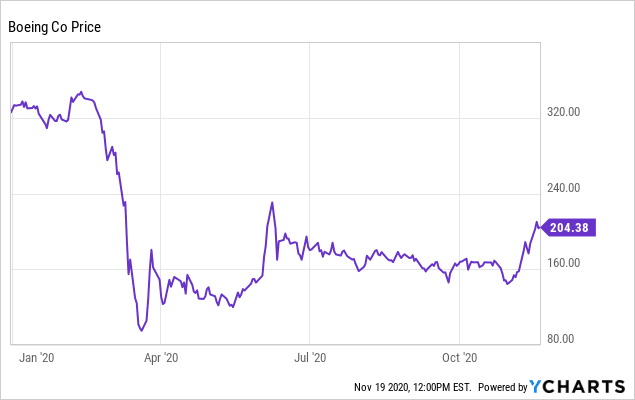
- Boeing stock has surged in recent weeks on hopes related to COVID-19 vaccine progress and the recertification of the 737 MAX.
- While air travel demand may return to 2019 levels by 2023 or 2024, demand for new aircraft will remain below the peak seen in 2018-2019 for the foreseeable future.
- The recent peak in new aircraft demand was a bubble (driven by fast-expanding, unprofitable airlines) that has decisively popped.
- Airbus’ substantial backlog and product advantage in the narrowbody market will give it a much higher share of annual deliveries going forward than it enjoyed previously.
- Boeing’s enterprise value is down just 21% since the beginning of 2019. Considering the deterioration in its prospects over that period, Boeing stock must fall further to reach fair value.
Shares of Boeing (BA) spent most of the past five months in a rut near $160. However, Boeing stock broke out a few weeks ago, surging above $200 on two pieces of good news. First, at least two COVID-19 vaccine candidates appear to be safe and about 95% effective: far better than most experts had dared hope. That paves the way for a mass vaccination campaign in 2021 that could bring the current pandemic to an end over the next year.
Second, there were growing signs that the FAA would soon recertify the Boeing 737 MAX, 20 months after grounding Boeing’s top-selling model. The recertification came on Wednesday causing Boeing stock to pop 7% in pre-market trading before pulling back with the rest of the market. Most other global aviation regulators are expected to follow suit in the coming weeks.
Both developments are obviously positive for Boeing. However, they aren’t the panacea that many investors make them out to be. A recovery in air travel demand does not mean that global aircraft deliveries will return to 2018 peak levels. Furthermore, Boeing’s market share is likely to be considerably lower over the next decade than it was over the past decade. Meanwhile, Boeing will exit the current crisis with far more debt than it has historically carried. As a result, Boeing stock is overvalued at prices near $200.
The replacement market isn’t very big
The International Air Transport Association (IATA) expects global air travel to recover to 2019 levels by 2024. Perhaps the IATA estimate is too gloomy in light of recent vaccine progress. Still, given the length of time it will take to immunize the global population, the macroeconomic impact of COVID-19, and the damage to airlines’ balance sheets, it’s unrealistic to expect a full recovery before 2023.
Yet, a full recovery in air travel demand doesn’t imply anything close to a full recovery in production. If we assume that the global airline industry needs the same number of aircraft in 2023 as it had in 2019, production between 2020 and 2023 only needs to cover the replacement of aircraft that are being retired during that period. (In fact, production wouldn’t quite need to match aircraft retirements, as nearly 400 already-delivered Boeing 737 MAX jets were grounded for most of 2019 and will return to active service by next year.)


