- Starbucks has cemented its position as the most recognizable coffee brand on the planet.
- Starbucks will continue to adapt and shift both its current stores and new stores to meet market demands.
- The combination of a strong balance sheet, first in class brand and room for global growth makes Starbucks an enticing buy.
Disruption to Opportunity
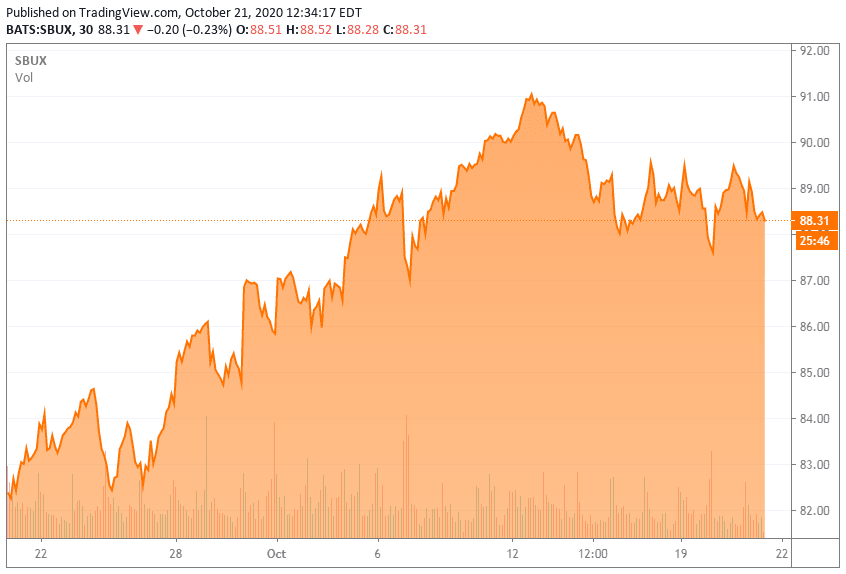
Since the start of the pandemic, markets have searched for opportunities and companies that would realize tailwinds during this downturn rather than the expected headwinds. This search has not just surrounded companies with existing models that were bolstered by digitization, but also for companies likely to or most able to adapt to changing market drivers. Unfortunately, not all businesses’ current model (NASDAQ: ZM) is seemingly tailored perfectly for a pandemic-stricken market’s demands. Similarly, not all companies’ models or management are agile or flexible enough to adapt to such drastic shifts in demand. Unfortunately, we can’t predict the future, and thus, seemingly well-grounded and logical expectations are not always realized. We can, however, look to the future, consider the past and try to discern good growth opportunities for years to come. Such is the case with Starbucks (NASDAQ: SBUX), which despite losing about 30% of its market cap during the lockdown has since recovered to its pre-COVID baseline and still shows promise of significant future growth from both strong fundamental and adept management.
Fundamentally, Starbucks has a very strong balance sheet. Just two years back, in 2018, Starbucks inked a royalty deal with Nestlé for the sale of its licensing and distribution business of consumer-packaged goods (CPG) worth $7 billion in cash upfront. That timely and fortuitous capital injection has added the necessary liquidity to give Starbucks an extra layer of flexibility in managing its capital expenditure and other cash flow activities during these difficult yet opportunistic times. In addition, over the last 3 years, Starbucks has returned a great deal of its capital to shareholders primarily in the form of share buybacks, reducing its overall dilution and shares outstanding from 1462mm in September 2017 to just 1169mm by June 2020. These fundamental strengths are particularly meaningful and important in the narrative for not just weathering the post-COVID era, but growing into it.
Second, Starbucks management team has proven time and time again that despite its size, it remains creative, malleable and agile – changing with the times to meet shifts in market demands. One of the issues Starbucks is currently faced with is its stores in more densely populated locales are faced with longer than usual wait times, resulting in a more severe loss of sales at these prime high traffic locations. To increase throughput, the company plans to roll out a new network of pick-up only stores and payment methods that include an auto-pay feature and reward points system.


