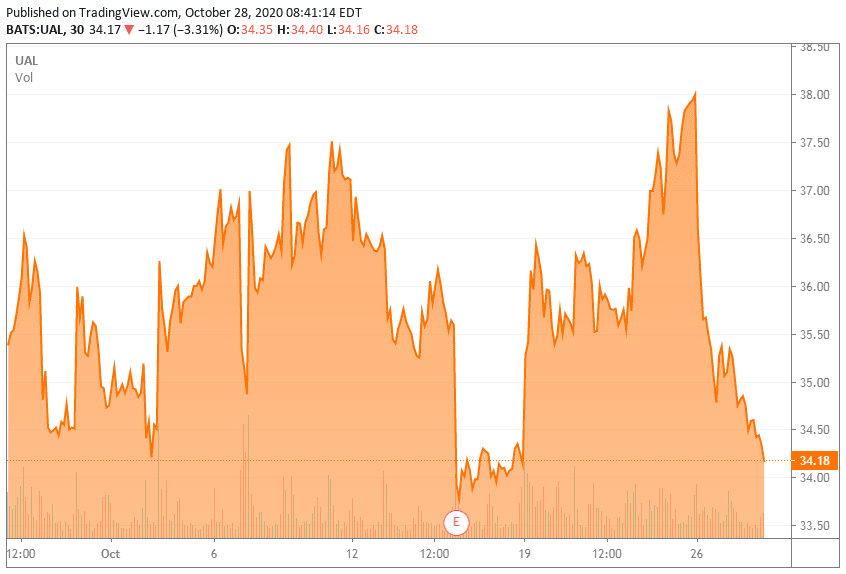
- While United Airlines managed to avoid a liquidity crisis, it will take a long time for it to return to profitability.
- With more than $30 billion in debt and the inability to issue dividends until 2026, the opportunity cost of holding the airline’s shares is too high at this stage.
- We stick with our opinion that United Airlines continues to be uninvestable and it’s better to avoid its stock.
- Looking for a helping hand in the market? Members of Best Short Ideas get exclusive ideas and guidance to navigate any climate. Get started today »
While United Airlines (UAL) managed to avoid a liquidity crisis, it will take a long time for it to return to profitability. With more than $30 billion in debt and the inability to issue dividends until 2026, the opportunity cost of holding the airline’s shares is too high at this stage. Considering the fact that the air travel industry will not recover to its 2019 levels at least until 2024, we decided to stick with our opinion that United Airlines continues to be uninvestable and it’s better to avoid its stock.
Investors Need to Stay Away
United didn’t have a lot of liquidity before the pandemic, and as a result, it was forced to raise massive amounts of money through debt and stock offerings in order to survive. While the airline managed to avoid insolvency in the first few months of the pandemic and will likely stay afloat, we don’t believe that it will be able to show a meaningful performance in the upcoming years. While its business is slowly recovering, it will take years for United and its peers to return to normalcy. In an effort to boost the travel activity, United decided to get rid of fees for changing dates on its US flights and it also plans to give its passengers the ability to fly standby for free on same day departures. While those efforts might slightly improve the company’s performance in the following months, we’re still a long way from a full recovery to pre-pandemic flight levels.
The latest earnings report for Q3 showed that United’s revenues declined by 78% Y/Y to $2.49 billion. While the decline was lower in comparison to Q2, in which the company’s revenues decreased by 87% Y/Y, the overall weak performance during the period only proves our point that we are a long way from recovery. During the quarter, United’s capacity was also down 70% Y/Y, while its load factor was only 47.8%, below the consensus of 48.7%. The airline also suffered a $1.8 billion loss in Q3, which was wider in comparison to the $1.6 billion loss that it suffered in Q2.
The problem with United is that it was forced to raise over $20 billion through debt and stock offerings in order to avoid bankruptcy. However, due to the weakened demand and a high cash burn, United’s total liquidity at the end of Q3 was already below $20 billion at $19.4 billion. Despite the fact that United cut its non-labor operating expenses by 63% and executed sale and leaseback deal, its average daily cash burn from July to September still was $21 million, while its daily severance payments stood at $4 million.


