Cummins is a global leader in the supply of diesel powertrains.
Due to its technical superiority, Cummins has been able to grow its market share and operating margins through the business cycle.
The COVID-19 inspired global recession is impacting sector demand and Cummins cannot escape this situation.
The sector is undergoing regulatory change, which is encouraging the introduction of alternative systems and will weaken Cummins’ market position over time.
Although currently fairly priced, investors need to keep an eye on the sector’s changing dynamics.
Company Description
Cummins Inc. (NYSE:CMI) is a global leader in diesel power systems. It designs, manufactures, distributes and services diesel, natural gas, electric and hybrid powertrains and powertrain-related component products, including filtration, after-treatment, turbo-charges, fuel systems, control systems, air-handling systems, automated transmissions, electric power generation systems, batteries electrified power systems, hydrogen generation and fuel cell products.
Products are sold to original equipment manufacturers (OEMs), distributors (both company-owned and independent) and end-users worldwide. The company operates in more than 190 territories and countries.
Cummins has been manufacturing diesel engines since 1919 (originally as the Cummins Engine Company). Although the company did not invent the diesel engine, it has been hugely instrumental in its development. The company started its global expansion very early and by 1960 was selling products to over 98 countries. More than 50% of the company’s sales come from outside of the US. The company was first publicly listed in 1947.
The company currently has 5 reportable operating segments:
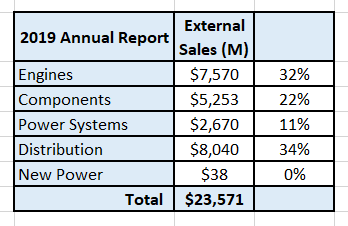
Source: Author’s compilation using data from Cummins’ 10-K.
Business Overview
Until 1991 Cummins was primarily a diesel engine company. In 1991 they introduced a natural gas engine for the commercial truck and bus market. Cummins historically manufactured diesel and gas-fired engines for the heavy and medium-duty truck, bus, recreational vehicle (RV), light-duty automotive (pickups and light commercials), construction, mining, marine, rail, oil and gas, defense, and agricultural markets.
Through a series of acquisitions over the last couple of years, Cummins is developing a business in supplying hybrid powertrains as well.
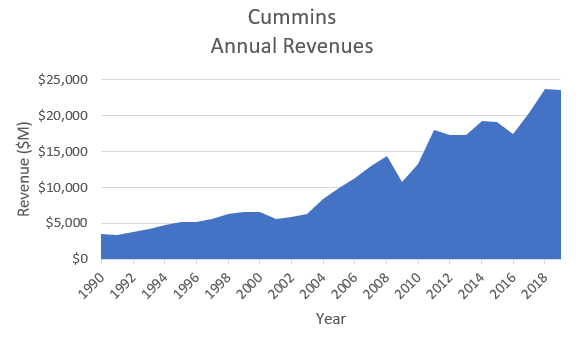
These markets are very cyclical. This can be demonstrated by looking at the long-term historical chart of Cummins’ revenues:


